Research

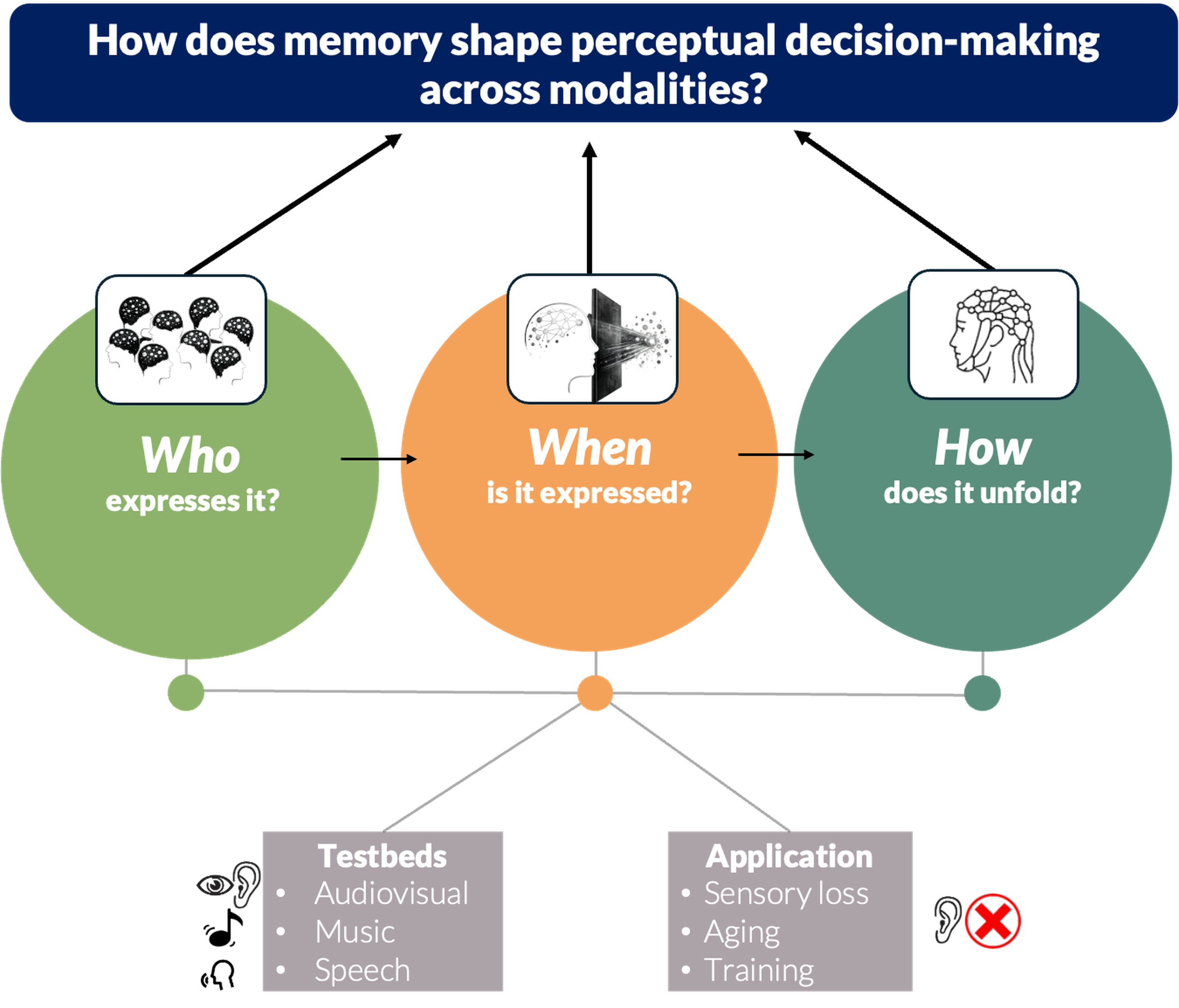
My work examines how the structure of internally stored information constrains perception. Across time, modalities, and individuals, I investigate how stored knowledge interacts with incoming sensory input, how these influences are flexibly weighted under changing task demands and levels of uncertainty, and how their structure can be quantified within shared measurement frameworks. I combine behavioural methods, electroencephalography (EEG), and statistical modeling to characterize these interactions.

1. Memory-Guided Perception

When does learned information shape what we perceive, and when does it remain silent?

What fascinates me is that learning does not guarantee expression. In studies of contextual cueing and memory-guided attention, my work demonstrates neural signatures of learning in the absence of behavioural benefit, revealing latent memory traces that do not automatically influence performance. This dissociation raises a central question: what determines whether stored information is merely available versus accessible when it is needed? I examine how attention during encoding, task instructions, awareness, and cognitive load regulate whether learned information influences perceptual decision-making. Rather than treating memory-guided perception as binary, this work characterizes it as a dynamic interaction between stored knowledge and current task demands.

Memory-Guided Perception figure

2. Multisensory Inference: Dissociating Prediction from Postdiction

How does context influence perception before a stimulus appears and after it unfolds?

Perception unfolds over time and integrates information across senses. My work examines how contextual information shapes perceptual judgments at distinct temporal stages. In some cases, prior knowledge generates predictions that bias interpretation before sensory input arrives; in others, later input retrospectively reshapes what was perceived. I test whether predictive and postdictive influences rely on shared or dissociable mechanisms, and how the system flexibly weights these influences as a function of timing, uncertainty, and task demands.

Multisensory Inference figure

3. Working Memory and Feature Structure Across Modalities

How does the structure of information across senses constrain perception?

To compare how information constrains perception across modalities, it must be characterized within a shared continuous feature space. In vision, circular feature spaces enable estimation of response precision and systematic bias along defined stimulus dimensions. Comparable approaches are now emerging in audition. In this line of work, I extend circular-space methods to align auditory and visual feature dimensions within a common continuous format, allowing direct cross-modal comparison and more systematic tests of multisensory integration.

Representational Structure figure

4. Music as a Window into Structure and Inference

How do internal expectations and external cues interact to organize complex musical scenes?

Music provides a richly structured yet dynamic environment for probing perceptual organization. I use orchestral materials to test how acoustic and score-based structure shape auditory grouping and perceptual prominence, and how experience modulates the weighting of these cues across musicians and non-musicians. In this way, music exposes how structured input and experience jointly constrain perceptual inference.

Music and Perceptual Organization figure

5. Perceptual Inference Under Sensory Degradation

How is stored knowledge leveraged for perception when sensory input becomes unreliable?

When sensory input becomes unreliable, successful perception is constrained to rely on internally stored knowledge to resolve ambiguity. I examine how voice familiarity supports speech intelligibility in noisy environments, particularly for older adults and individuals with hearing loss. By testing how training-induced talker familiarity improves speech perception in noise and how individual differences in sensory and cognitive factors shape these benefits, this work uses sensory degradation as both a clinically relevant challenge and a principled test of how internal knowledge compensates for reduced signal reliability.

Real-World Applications figure